

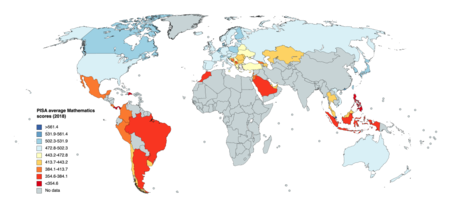
PISA average Mathematics scores (2018)
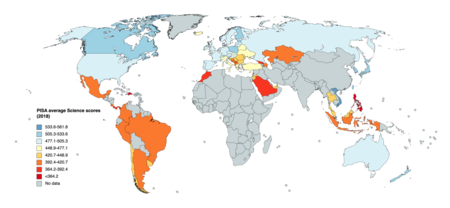
PISA average Science scores (2018)

PISA average Reading scores (2018)
Every three years in the worldwide education systems, OECD conducts PISA to test the critical thinking of 15-year-olds in math, science, and reading in over 65 countries that make up 90% of the world’s economies.
- Method of testing
- Influence and impact
- Countries With Highest PISA Scores
- PISA 2022
- 2018 PISA Score by Country
- Сравнение рейтингов 2003—2015
- What Is PISA? Why Does It Matter?
- Международная программа по оценке образовательных достижений учащихся
- PISA results for the United States by race and ethnicity
- PISA 2018 ranking summary
- Countries With Lowest Pisa Scores
- Scores By Country
- Global Education Standards
- Research on possible causes of PISA disparities in different countries
Method of testing
The students tested by PISA are aged between 15 years and 3 months and 16 years and 2 months at the beginning of the assessment period. The school year pupils are in is not taken into consideration. Only students at school are tested, not home-schoolers. In PISA 2006, however, several countries also used a grade-based sample of students. This made it possible to study how age and school year interact.
To fulfill OECD requirements, each country must draw a sample of at least 5,000 students. In small countries like Iceland and Luxembourg, where there are fewer than 5,000 students per year, an entire age cohort is tested. Some countries used much larger samples than required to allow comparisons between regions.
PISA test documents on a school table (Neues Gymnasium, Oldenburg, Germany, 2006)
In selected countries, PISA started experimentation with computer adaptive testing.
Countries are allowed to combine PISA with complementary national tests.
Influence and impact
More important than its influence on countries’ policy of student assessment, is the range of ways in which PISA is influencing countries education policy choices.
Countries With Highest PISA Scores
The top ten countries with the highest Program for International Student Assessment (PISA) scores are China, Singapore, Estonia, Japan, South Korea, Canada, Taiwan, Finland, Poland, and Ireland.
Leading the pack is China with an impressive overall PISA score of 578.7. Singapore secures the second spot with a score of 556.3, and Estonia ranks third with a PISA score of 525.3.
Japan boasts an overall score of 520.0, positioning itself as the fourth country with the highest PISA scores. Close on its heels is South Korea with a PISA score of 519.7.
Canada, sharing the sixth spot with Taiwan, has an overall PISA score of 516.7. Finland’s PISA score is 516.3, earning it eighth place in the ranking.
Poland also features in the top ten with a PISA score of 513.0, while Ireland rounds off the list with an overall PISA score of 504.7.
10 Countries with Highest PISA Scores:
- China — 578.7
- Singapore — 556.3
- Estonia — 525.3
- South Korea — 519.7
- Canada — 516.7
- Taiwan — 516.7
- Finland — 516.3
- Ireland — 504.7
PISA 2022
Typically, PISA is on a three-yearly cycle, but due to the COVID-19 pandemic, PISA 2021 was postponed to 2022.
85 countries are taking part in PISA 2022, intended to take place from 26 July to 16 September 2022. Three key learning subject areas are tested: reading literacy, mathematics, and science. These are accompanied by an innovative domain that varies from cycle to cycle. Mathematics is the key focus, while creative thinking is the innovative domain.
Around 6,300 students aged between 15-years-3-months and 16-years-2-months at the time of assessment will participate in the PISA 2022 Main Survey, conducted under the auspices of the OECD.
2018 PISA Score by Country
The latest PISA results information is PISA 2018 results
With a mean score of 1,736, China topped the list ahead of Singapore in the second spot and Estonia in the third spot. The United States only made it into 22nd place with a total average score of 1,485, just slightly above the 1,465 average scores for all OECD countries assessed.
China’s apparent dominance of this measure of student attainment was somehow taken with a pinch of salt. Unlike the other countries assessed, China’s scores were based on pupils in Beijing, Shanghai, and its two neighboring provinces — Jiangsu and Zhejiang, home to just 183 million of China’s 1.4 billion inhabitants. However, the report did note that the level of income of these Chinese regions is well below the OECD average.
Сравнение рейтингов 2003—2015
The PISA mathematics literacy test asks students to apply their mathematical knowledge to solve problems set in real-world contexts. To solve the problems students must activate a number of mathematical competencies as well as a broad range of mathematical content knowledge. T IMSS, on the other hand, measures more traditional classroom content such as an understanding of fractions and decimals and the relationship between them (curriculum attainment). P ISA claims to measure education’s application to real-life problems and lifelong learning (workforce knowledge).
PISA also assesses students in innovative domains. In 2012 and 2015 in addition to reading, mathematics and science, they were tested in collaborative problem solving. In 2018 the additional innovative domain was global competence.
What Is PISA? Why Does It Matter?
Programme for International Student Assessment (PISA) is a global program whereby around 600,000 15 year students from different countries are put under a two-hour test to gauge their skills and knowledge, mainly in science, reading, and mathematics. P ISA test questions don’t gauge memorization of facts but demand that students draw on real-world problem-solving skills and knowledge.
Since a high ranking on PISA corresponds to economic success, researchers have concluded that PISA is one of the indicators of whether school systems are preparing students for the 21st-century global knowledge economy.
U. S. critics of PISA state that the state has a higher percentage of disadvantaged children and therefore cannot fair as well as other OECD countries on the test. Data from the OECD shows that the U. S actually has around the OECD average of disadvantaged students.
However, the U. S has more students from socio-economically advantaged backgrounds. Meaning students in the U. S are better off than the average OECD country.
Международная программа по оценке образовательных достижений учащихся
Текущая версия страницы пока не проверялась опытными участниками и может значительно отличаться от версии, проверенной 28 октября 2021 года; проверки требуют 30 правок.
Международная программа по оценке образовательных достижений учащихся (англ. Programme for International Student Assessment, PISA) — тест, оценивающий функциональную грамотность школьников в разных странах мира и умение применять знания на практике. Проходит раз в три года. В тесте участвуют подростки в возрасте 15 лет. Был разработан в 1997 году, впервые прошёл в 2000 году. Тест организует Организация экономического сотрудничества и развития в консорциуме с ведущими международными научными организациями, при участии национальных центров. Руководит работой консорциума Австралийский совет педагогических исследований (ACER) при активном содействии Нидерландского национального института педагогических измерений (CITO), Службы педагогического тестирования США (ETS), Национального института исследований в области образования (NIER) в Японии; Вестат США (WESTAT) и других авторитетных в мире образования организаций.
Выводы исследования за 2012 год «Maths» (Математика).
Выводы исследования за 2012 год «Science» (Естественные науки).
Выводы исследования за 2012 год «Reading» (Чтение).
В исследовании принимают участие страны-участницы Организации экономического сотрудничества и развития, а также те страны, которые взаимодействуют с ОЭСР. Количество таких стран каждый раз существенно увеличивается.
Исследование PISA является мониторинговым, оно позволяет выявить и сравнить изменения, происходящие в системах образования в разных странах, и оценить эффективность стратегических решений в области образования. Мониторинг качества образования в школе PISA проводится по четырём основным направлениям: грамотность чтения, математическая грамотность, естественнонаучная грамотность и компьютерная грамотность. Согласно итогам исследования PISA 2000—2015, лучшее среднее образование в странах Восточной Азии: Китае, Корее, Сингапуре, Японии, в Европе в десятке лидеров Финляндия, Эстония, Швейцария, Польша и Нидерланды.
In the article, Professor Harvey Goldstein of the University of Bristol was quoted as saying that when the OECD tries to rule out questions suspected of bias, it can have the effect of «smoothing out» key differences between countries. » That is leaving out many of the important things,» he warned. » They simply don’t get commented on. What you are looking at is something that happens to be common. But (is it) worth looking at? PISA results are taken at face value as providing some sort of common standard across countries. But as soon as you begin to unpick it, I think that all falls apart.»
Since 2012 a few states have participated in the PISA tests as separate entities. Only the 2012 and 2015 results are available on a state basis. Puerto Rico participated in 2015 as a separate US entity as well.
PISA results for the United States by race and ethnicity
PISA never combines mathematics, science and reading domain scores into an overall score. However, commentators have sometimes combined test results from all three domains into an overall country ranking. Such meta-analysis is not endorsed by the OECD, although official summaries sometimes use scores from a testing cycle’s principal domain as a proxy for overall student ability.
PISA 2018 ranking summary
В 2009 году в исследовании принимали участие уже 74 страны.
Грузия по чтению набрала 374 балла (67-е место), по математике — 379 баллов (65-е место), по научной грамотности — 373 балла (69-е место).
Countries With Lowest Pisa Scores
10 Countries with the Lowest PISA Scores:
- Dominican Republic — 334.3
- Kosovo — 361.3
- Lebanon — 376.7
Scores By Country
Long ass metric name here
Global Education Standards
Education is vital to both individual development and societal progress. One of the tools used to gauge the quality of education worldwide is the Programme for International Student Assessment (PISA). Conducted every three years by the Organisation for Economic Co-operation and Development (OECD), PISA assesses the knowledge and skills of 15-year-old students around the globe in reading, mathematics, and science.
Although the United States harbors many of the world’s top universities, it may come as a surprise that the nation’s PISA scores do not mirror this prestige. The U. S ranks below countries such as Canada, Finland, and Poland, which consistently perform above the OECD average.
Key findings from the data include:
This article will delve deeper into these scores by country, exploring the factors contributing to students’ performance at both ends of the spectrum, and what implications these scores might have for the future of global education.
Research on possible causes of PISA disparities in different countries
Страны-члены ОЭСР и ассоциированные партнеры решили отложить оценку PISA 2021 до 2022 года, а оценку PISA 2024-до 2025 года, чтобы отразить трудности, возникшие после Covid.
PISA 2022 будет посвящена математике с дополнительным тестом на творческое мышление. Недавно была запущена новая математическая система PISA 2022.
Подготовка к этому тесту ведется с участием участников из 38 стран-членов ОЭСР и, вероятно, более 50 стран, не являющихся членами.


